Wedding Guest Outfit: How to Nail It Without Second-Guessing Yourself
Disclosure: This article is written by the Dress Better team. We built the product described here and use it ourselves — including for the scenarios in this article.
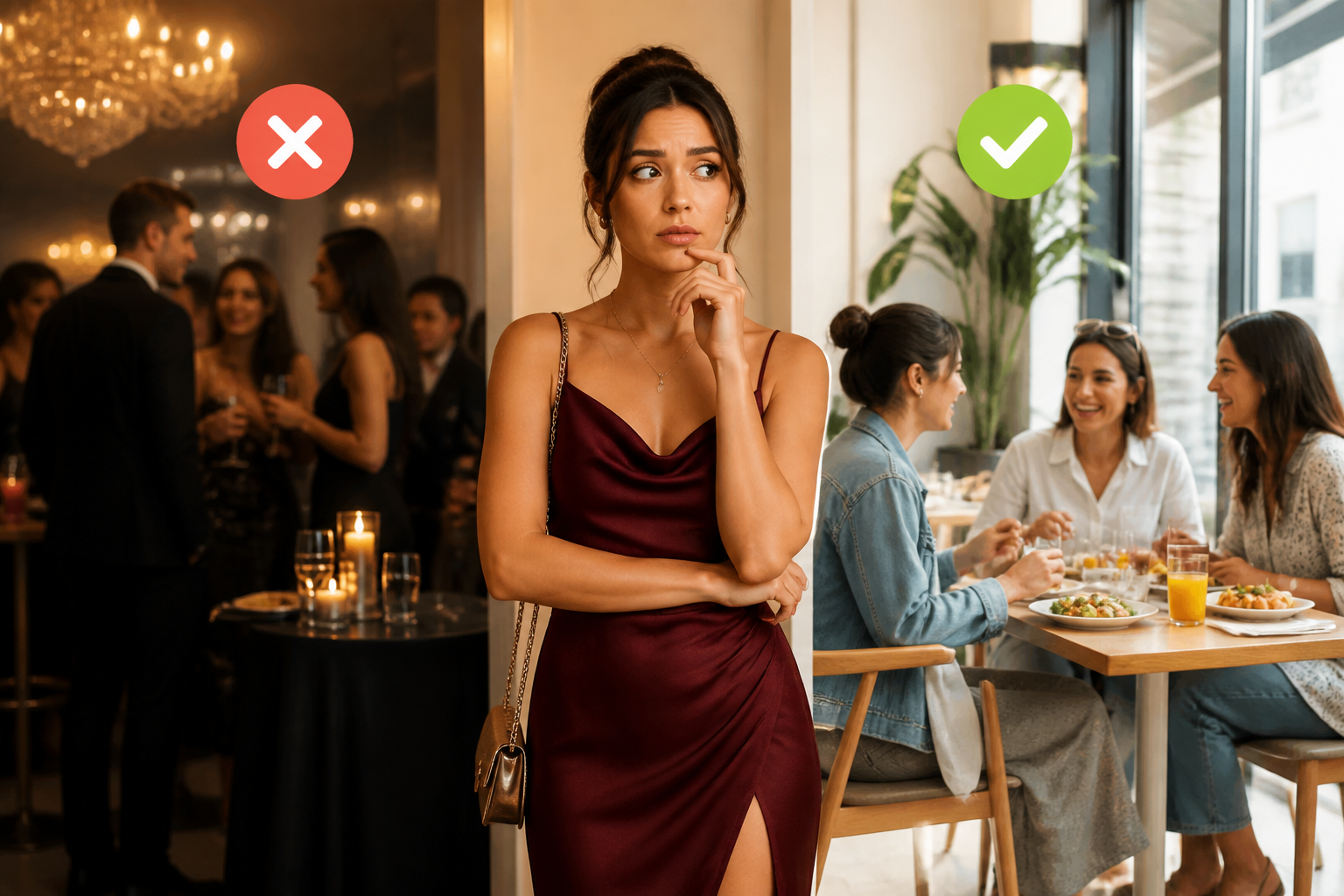
The week before a wedding, your closet suddenly looks completely useless.
You have a dinner party dress that might work. A floral midi you're not sure reads "garden party" or "garden party gone wrong." A blazer that could elevate something — but what? You've scrolled Pinterest for 45 minutes and are somehow less certain than when you started.
This is a universal experience. It's not that people don't own nice clothes — most people attending a wedding absolutely do. The problem is that "nice" isn't the same as "right for this specific occasion." The stakes feel unusually high: you'll be photographed, you'll see people you haven't seen in years, and there's an unwritten dress code that nobody actually hands you.
A few patterns come up over and over when people get this wrong. The most common is wearing something that looked great at a previous dinner or event without accounting for the specific context of a wedding — the combination of ceremony, reception, and photographs across a full day. The second is misjudging the venue formality. A dress that's perfectly calibrated for a rooftop bar event reads completely differently at a chapel ceremony, even if the fabric and silhouette are identical. The third — and the one people talk about least — is the color issue, which isn't just "don't wear white" but a more complex question of whether your palette photographs well and signals the right occasion tier.
The search data reflects this anxiety directly: "wedding guest outfit" draws 2.4K monthly searches at near-zero competition (KD 0), sitting alongside "first date outfit ideas" at the same volume. Social media amplifies the pattern — users posting about first date looks, dinner date outfits, picnic date styling, and wedding guest dressing treat these as a connected cluster of high-stakes occasions. One widely-shared post by @RealAmirahLeia crystallizes exactly this: the outfit question for a high-stakes occasion is never "what should someone wear" — it's "does this specific thing I own actually work."
Dress Better is built for that question — not to recommend what to buy, but to tell you honestly whether what you already own will land.
Why Wedding Guest Dressing Is Genuinely Difficult
Wedding dress codes operate on a spectrum that's only partly about formality. According to wedding etiquette resources including The Knot and Brides Magazine , the most common guest mistakes fall into three categories: underdressing for the venue, color choices that photograph poorly, and proportion issues that look fine in a mirror but read as sloppy in photos.
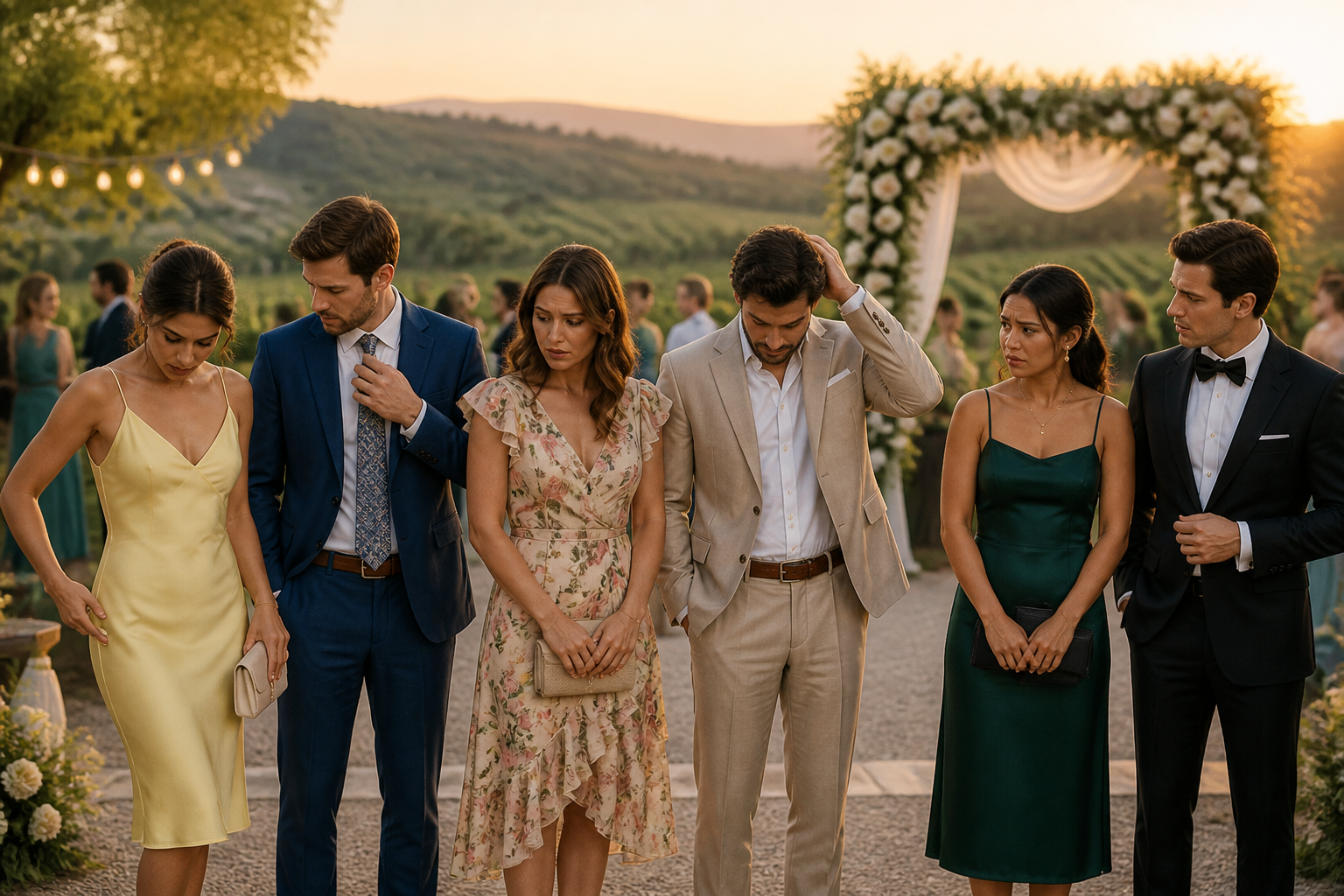
Three variables create the difficulty:
Occasion appropriateness is contextual, not universal. "Semi-formal" at a vineyard ceremony in the Napa Valley is not the same as "semi-formal" at a downtown hotel ballroom. The question isn't whether your outfit fits a category — it's whether it reads as considered and appropriate for this specific event's tone, venue, and couple. A wrapdress that photographs beautifully at a beach wedding can feel conspicuously casual at a ballroom reception two miles away.
Color choices go beyond "don't wear white." A deep burgundy midi can read elegantly formal or festively casual depending on the fabric, cut, and what you pair it with. According to color theory principles used in professional styling, color relationships within an outfit determine perceived formality as much as the color itself — a muted palette in crepe signals something different than the same hue in cotton poplin. Dusty rose in silk charmeuse signals something entirely different than dusty rose in a cotton-blend jersey.
Proportions for photographed events expose fit issues that everyday wear masks. Research on visual perception in fashion — including work cited by the Fashion Institute of Technology on how camera lenses flatten and compress silhouettes — shows that proportions that look balanced in a standing mirror can read as off in photographs. Weddings involve seated ceremony, cocktail-hour standing, and (often) dancing, each of which tests an outfit differently. A midi dress that drapes well standing up can bunch awkwardly seated; a blazer that looks structured in a mirror can gap open in candid photos.
None of this requires owning different clothes. It requires accurately reading the clothes you already own — which is a harder skill than most people give it credit for, because it requires evaluating your outfit the way a camera and a crowd will see it, not the way a bathroom mirror does.
The Ask-a-Friend Problem
Most people's actual process for validating a wedding guest outfit involves asking someone nearby — a partner, a roommate, a coworker. The feedback they get is almost always "you look great."
This isn't useful, but it's not dishonest either. The people who care about you will default to reassurance because the alternative — "that color is washing you out" or "the proportions are off" — requires a level of specific fashion literacy most people don't have, delivered in a way that won't start an argument two hours before a wedding. And the friend who does have the fashion literacy knows that giving honest critical feedback to someone standing in front of them in an outfit they clearly like is a social minefield.
It's also worth noting what "you look great" actually measures: whether you look good to that specific person, in that specific lighting, in that moment. It doesn't measure how the outfit reads in outdoor afternoon light. It doesn't account for what the outfit will look like in photos. And it doesn't evaluate whether the outfit is appropriately calibrated for the specific wedding — something your friend might not even know enough about to assess.
When we ran wedding guest outfit scenarios through Dress Better during development, this gap was one of the clearest things we observed. Photos that looked "fine" in normal room lighting showed color clashes that only became visible once the AI evaluated the full palette together. Proportions that read as balanced standing flagged differently once the AI applied the "photographed event" context. The feedback wasn't "this is bad" — it was consistently specific: this hem length against this heel height creates a visual break at the wrong point; this top-to-bottom value contrast is higher than the occasion tier warrants.
A 2023 survey by fashion platform Stylitics found that 67% of consumers report feeling uncertain about outfit choices for special occasions despite owning appropriate clothing — the gap isn't wardrobe, it's feedback quality. The same study found that specific, criterion-based feedback (color, fit, occasion fit) produced significantly higher confidence scores than general approval.
Dress Better is designed around that feedback gap. Upload a photo of the outfit you're considering, and the AI evaluates it across four dimensions used in professional styling assessment:
- Color coordination — does the palette work together, and does it signal the right formality level for a wedding context?
- Proportions — are the lengths, volumes, and silhouette balanced in a way that photographs well?
- Materials — do the fabrics complement each other in weight and texture, and do they signal the right occasion tier?
- Occasion fit — does this outfit read as appropriate for an event where you're a guest, not the focus?
The feedback is specific and incremental. It identifies what's working, what to adjust, and what that adjustment would look like — not "great choice" and not "start over."
How to Use Dress Better for Your Wedding Guest Outfit
The process takes under two minutes:
Step 1: Put on the full outfit. That means the shoes, accessories, and the bag you're actually planning to carry. The AI evaluates the complete look — individual pieces in isolation won't give you an accurate read on color relationships and proportions.
Step 2: Take a full-body photo. Stand against a plain background with your full silhouette visible. You can upload via file picker or paste directly (Cmd+V). No height or weight input, no style preference questionnaire — a single photo is all the system needs.
Step 3: Get the analysis. Dress Better returns feedback on all four dimensions plus a visual before/after comparison showing the specific adjustments. The comparison image is particularly useful for occasion dressing — it shows what the suggested change looks like on your actual outfit, eliminating the need to hunt for reference images or imagine the result.
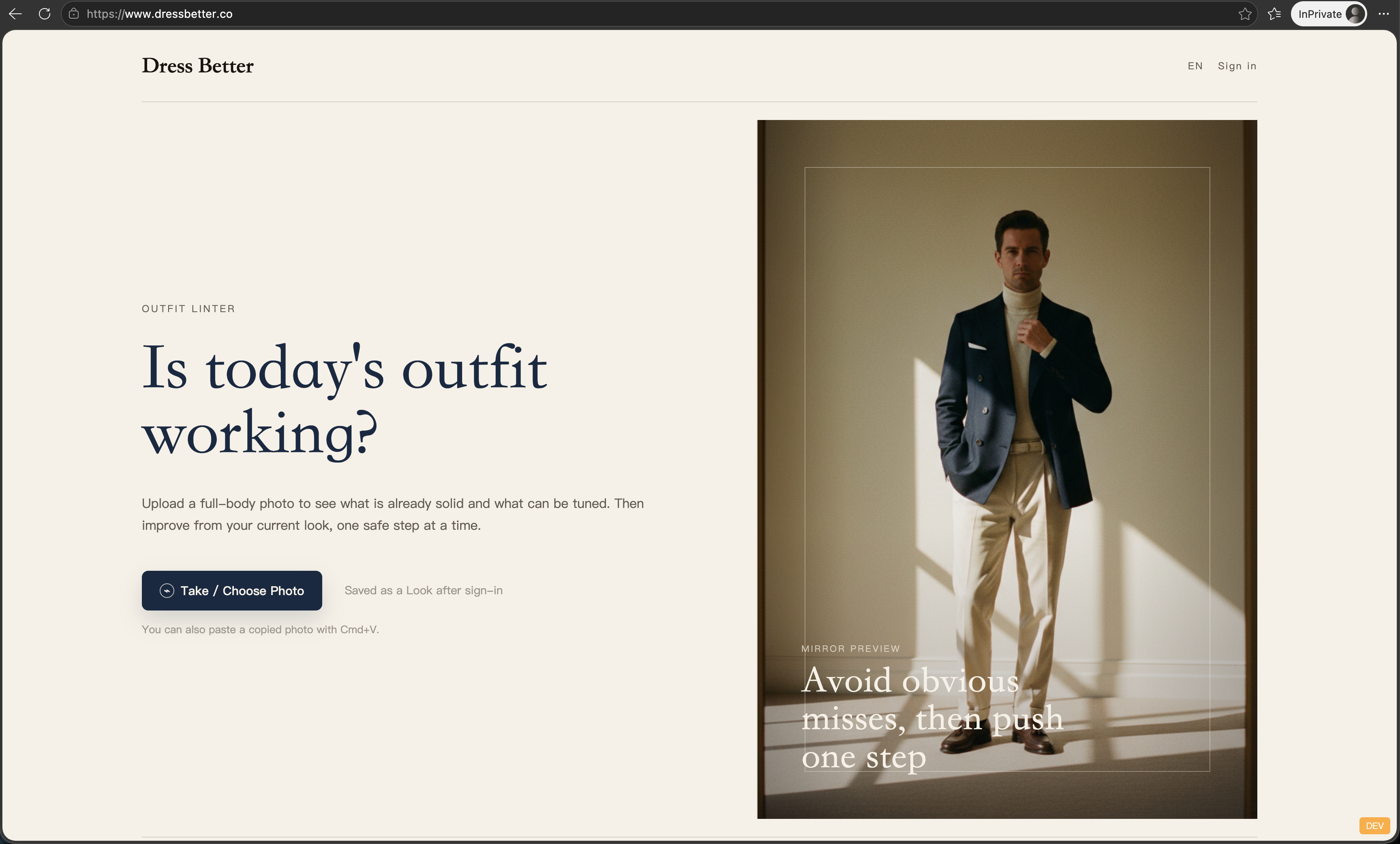
If you're deciding between two options, run both. The side-by-side data often resolves the decision in a way that mirror-checking doesn't. You can try it at dressbetter.co .
What the AI Actually Evaluates: The Four Dimensions in Practice
When you run an outfit photo through Dress Better, the AI is evaluating specific signals across four dimensions. Understanding what it's looking for helps you think about your own outfit more precisely — even before you upload anything.
Color Coordination for Weddings
The guidance everyone knows is "don't wear white." The more useful question is whether your color choices photograph well together and signal the right formality level.
Professional colorists distinguish between hue (the color itself), value (how light or dark it is), and saturation (how vivid or muted). An outfit where all three dimensions are in balance tends to read as intentional and occasion-appropriate. A dress with high saturation paired with accessories at low saturation creates visual conflict that photographs as "something is off" even when the individual pieces are fine.
Two common color errors in wedding guest outfits: (1) wearing a print where the secondary color competes with the primary — a floral where the background tone is nearly as visually loud as the main color, creating a busy look that reads as unresolved in photos; (2) wearing a monochrome look in a fabric where the color shifts across different lighting, which can look polished indoors and oddly washed-out in outdoor ceremony photographs.
Dress Better's color evaluation looks at these relationships within the complete outfit, not just individual items. It flags when combinations clash, when the palette reads too casual for the occasion, or when contrast levels will compress poorly in photographs.
Proportions Under Event Conditions
Weddings test proportions across multiple modes: seated ceremony, cocktail hour standing, and (often) dancing. An outfit that looks sharp in a standing mirror can lose structure after four hours.
Specific proportion issues that routinely catch people off guard at weddings:
- Midi hemlines and heeled shoes: A midi that hits mid-calf with flat shoes can look deliberately elegant. The same dress with a kitten heel often reads shorter and less polished — the heel shortens the visual leg before the hem takes over. With a block heel it reads differently again.
- Sleeve length vs. neckline: A wide-set neckline on a sleeveless dress broadens shoulders and reads casual at a formal event unless balanced with earrings that bring the eye upward. The same dress with a delicate neckline reads completely differently.
- Blazer proportions when seated: A cropped blazer that hits at the hip while standing rides up to the waist when seated, changing the silhouette significantly in the ceremony photos where everyone is sitting for 30–60 minutes.
The before/after comparison in Dress Better visualizes proportion adjustments in context. According to the product's design documentation at dressbetter.co , the system focuses on "incremental, safe improvements" rather than complete overhauls — so the feedback tends toward specific tweaks (hem length, sleeve proportion, shoe height relative to trouser break) rather than starting-over suggestions.
Material Signals
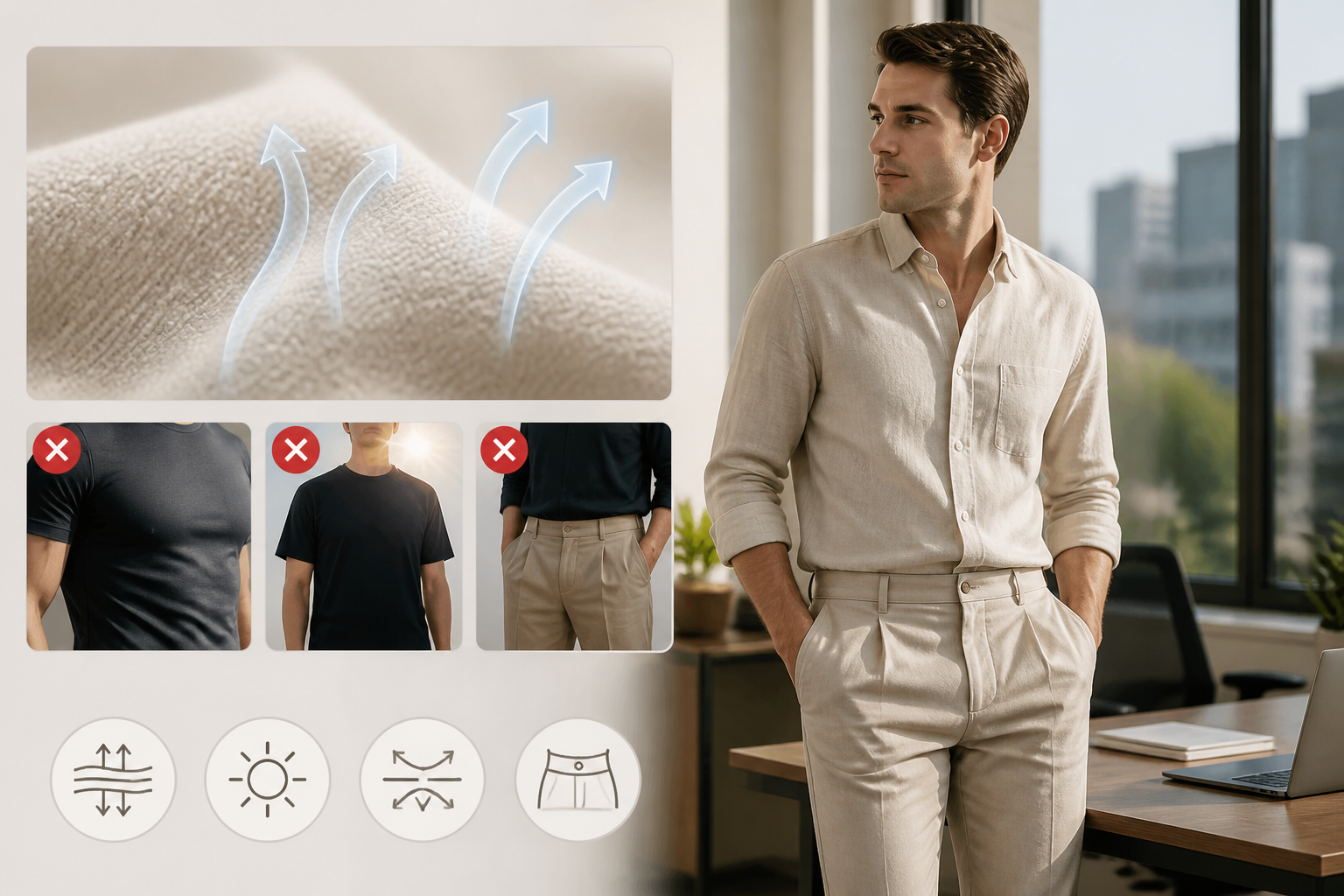
Chiffon and crepe signal formality differently than cotton or linen, even at similar price points and silhouettes. A technically expensive dress in a casual fabric will read as casual. This is one of the hardest dimensions to self-evaluate because it requires knowing how materials photograph and how they drape differently across the course of a full-day event.
Specific material patterns that affect how wedding guest outfits read:
- Linen in warm weather: Linen is appropriate for garden ceremonies and outdoor venues, but it creases over the course of a day. An outfit that looks crisp at 2pm will look lived-in by the reception at 7pm. If the venue is indoors or the event is a full day, a linen-blend or structured synthetic drapes better for the duration.
- Matte vs. sheen at evening receptions: Matte fabrics (wool crepe, ponte, cotton sateen) read lower-key than fabrics with sheen (satin, silk charmeuse, metallic jacquard). Pairing a matte dress with sheen accessories works. Wearing head-to-toe satin at a daytime ceremony can read as overdressed even if the silhouette is conservative.
- Knit fabrics at formal events: A well-cut knit midi might photograph beautifully, but the fabric signals "comfortable" rather than "considered" at formal and semi-formal ceremonies. This isn't a rule — it's a signal, and the AI evaluates it against the occasion tier.
The AI evaluates fabric combinations — whether the materials in your outfit work together in weight and texture, and whether the overall material story signals the right occasion tier.
Occasion Fit: Reading as a Guest, Not a Focal Point
The specific challenge of wedding guest dressing is calibration: you want to look considered and put-together without visually competing with the wedding party. This isn't about being less stylish — it's about occasion awareness.
The most common miscalibration: wearing an outfit more formal than the ceremony setting warrants. A floor-length gown at a casual outdoor ceremony draws attention in the wrong direction. A heavily embellished cocktail dress at a daytime garden wedding reads as competing with the bridal party. The direction of error matters — underdressing for a formal wedding is more forgivable than overdressing for a casual one, because underdressing reads as a judgment error and overdressing reads as a priority error.
Occasion fit evaluation looks at whether the complete outfit reads as guest-appropriate for a wedding versus a gala, a casual garden party, or a business dinner. The AI draws on training data across occasion types to flag when something is skewing too formal, too casual, or in the wrong direction for a ceremony-and-reception format.
Building a Wardrobe That Works Across High-Stakes Occasions
The wedding guest outfit question doesn't exist in isolation. The same uncertainty shows up across a narrow band of occasions where the stakes are meaningfully higher than everyday: first dates, dinner dates, work presentations, and events where you'll be photographed or judged on first impression.
"First date outfit ideas" draws 2.4K monthly searches at KD 5 — almost identical signal volume to "wedding guest outfit." Users treating these as related categories are correct: the underlying question is the same. Does this specific outfit work for this specific context where the stakes are higher than normal?
Dress Better is designed for this entire category, not just weddings. The same photo-and-analysis process that validates a wedding guest outfit works for the dinner the night before, the brunch the morning after, and the first date the following Thursday.
Because every analysis is automatically saved as a "Look" after login — preserving the original photo, AI feedback, and comparison image — you accumulate a personal reference library of what you've worn and what worked. Before the next high-stakes occasion, you can browse your Look History and pull something already validated rather than starting the uncertainty loop from scratch.
A Practical Note on Dress Codes
For completeness, here's how the most common wedding dress codes translate in practice, using the occasion-fit logic that Dress Better applies:
Black tie / formal: Floor-length gown or elegant cocktail dress. Suit for men. Material quality is load-bearing — formal dress codes are where fabric signals matter most.
Cocktail / semi-formal: Knee-to-midi length dresses, dressy jumpsuits, or a sharp suit. The risk zone: this is where "semi-formal" gets interpreted most variably by venue and region.
Smart casual / garden party: More latitude, but the occasion-fit dimension still matters. A linen blazer over trousers reads differently than a linen shirt with chino shorts even at the same formality tier.
Casual: The trap category. "Casual" at a wedding still means considered. Jeans are almost always wrong regardless of what the invitation says.
The general framework is useful. The specific answer for your specific outfit requires actually looking at it — which is what Dress Better does.
The Question Worth Answering
Most "wedding guest outfit" content gives you a list of what to wear in theory. That's not the question people are actually searching from. The question is whether the specific dress, the specific shoes, and the specific accessories you're planning to walk out the door with are going to land correctly.
That question requires looking at your actual outfit with honest eyes — something a mirror can't quite do, and a kind friend won't quite do.
Upload your outfit to Dress Better , get the specific feedback, and leave the house certain for once