What Should I Wear? How AI Outfit Scoring Answers That Question
The question "what should I wear?" sounds simple. But every morning, it carries a real weight — you're making a judgment call about color, fit, occasion, and what you want to project, often in under two minutes, with no objective feedback.
That gap between "I think this looks fine" and "this actually works" is exactly what people are reaching for when they post outfit photos online asking for ratings. A search of social media in early 2026 surfaced 57+ posts in a single week asking for outfit ratings — gym looks, beach outfits, casual wear, first-date fits. The pattern is consistent: people aren't asking for shopping recommendations. They're asking for honest, specific validation of what they're already wearing.
This piece breaks down why that question is harder to answer than it looks, what separates useful outfit feedback from noise, and how Dress Better approaches it — analyzing your actual outfit with AI rather than pointing you toward a new purchase.
Why "What Should I Wear?" Is Harder Than It Looks
Getting dressed seems automatic until it isn't. Here's why the question is genuinely difficult to answer on your own:
You can't see yourself the way others do. Mirrors distort perspective, lighting in your bedroom differs from lighting at work, and our eyes are trained to skip over problems we've normalized. A top that looks fine under warm bathroom lighting can read as faded or mismatched in an office fluorescent environment — the outfit hasn't changed, but the read has.
Generic advice doesn't map to your body, wardrobe, or context. "Wear navy" means nothing when you're trying to decide if this particular navy jacket works with these trousers for this specific meeting. Style rules that apply to one body type or context actively backfire in another.
Outfit combinations have non-obvious failure points. A fit can fall apart because of one subtle thing — a proportion mismatch, a fabric that clashes with another fabric's texture, a color that reads differently in a photo than in person. Pattern mixing follows rules that aren't instinctive: a fine check and a large stripe can coexist; a medium check and a medium stripe rarely do. Most people can't articulate what's wrong even when something feels off.
Feedback from others is filtered through their preferences. A friend who gravitates toward minimal dressing will push you toward monochromatic outfits. Someone with maximalist taste will tell you to add more. Neither opinion is calibrated to what you're trying to communicate.
That's the core problem. And it's why structured rating tools, when they work well, are genuinely useful rather than gimmicky.
What "Rate My Outfit" Actually Means (When It's Done Right)
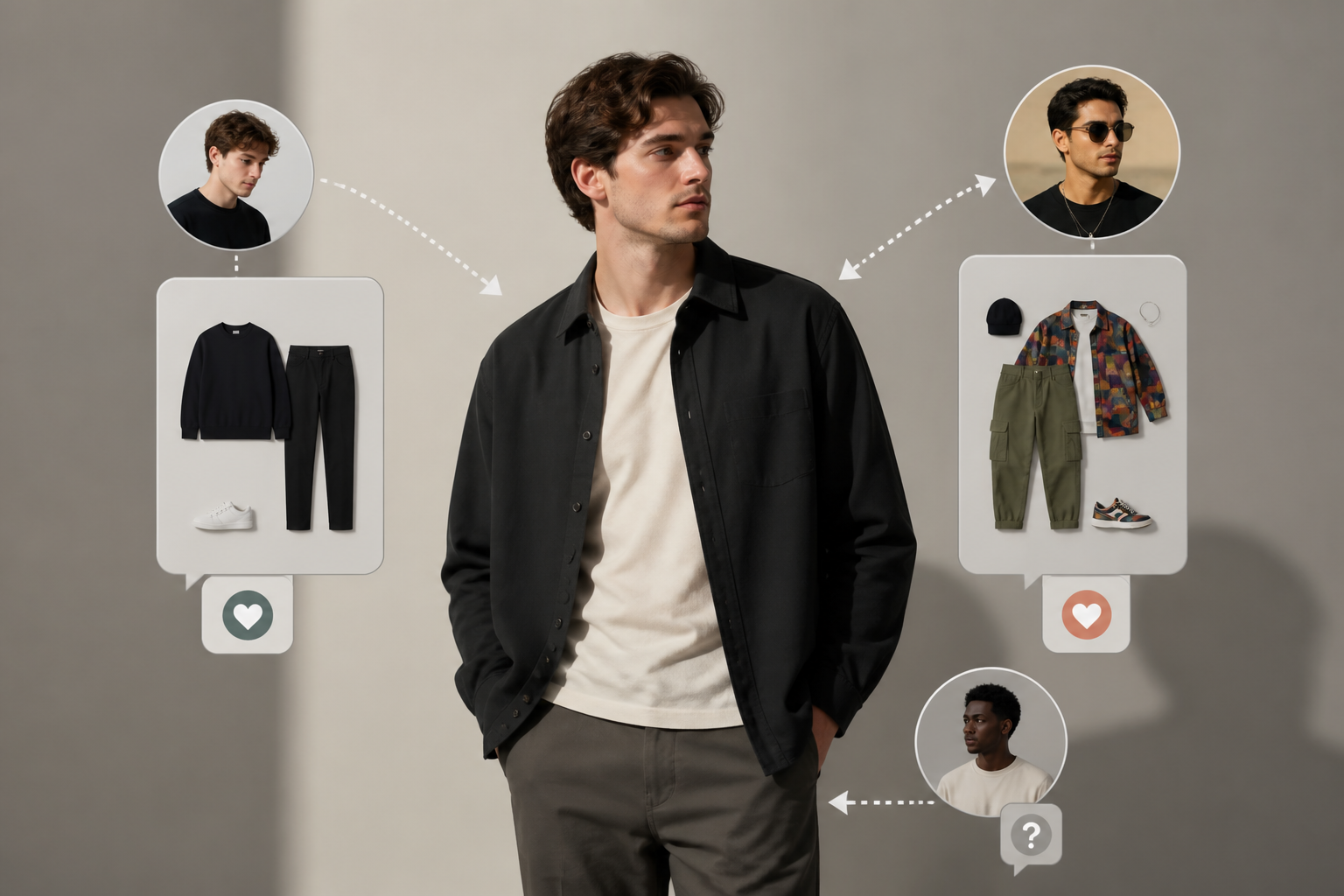
On social platforms, "rate my outfit" posts consistently get real engagement because people trust honest community feedback over generic style advice. But crowd-sourcing has limits: responses are slow, inconsistent, filtered through personal taste, and often vague ("looks great!" doesn't help you understand why).
When people post asking for outfit ratings, they're usually looking for one of three things: confirmation that a choice works, identification of what's specifically off, or a concrete fix they can act on before they walk out the door. Most crowd-sourced feedback delivers only the first.
An AI outfit rater works differently. It doesn't have aesthetic preferences — it evaluates based on established principles of color theory, proportion, and context-appropriateness. The result is faster, more consistent, and often more useful precisely because it's not trying to impress you or be polite.
What makes a rating tool actually helpful:
- Specificity over scores. A 7/10 is useless. "The contrast between your top and trousers is low, which flattens your silhouette — a slightly lighter trouser would fix this" is actionable.
- Incremental fixes, not overhauls. The best feedback doesn't tell you to start over. It identifies the one or two adjustments that would materially improve what you're already wearing.
- Context awareness. "Does this work for the gym?" and "does this work for a client dinner?" require different evaluation criteria. Occasion-appropriateness has to be part of the analysis — a technically well-coordinated outfit can still be wrong for the context.
- Consistency. Human feedback shifts based on who you ask and when. An AI evaluation applies the same criteria to your outfit at 7am Tuesday as it does at noon on Saturday.
How Dress Better Answers "What Should I Wear?"
Dress Better is an AI outfit analyzer that treats your existing outfit as the starting point — not a shopping cart.
Here's how the flow works:
1. Upload a full-body photo of your outfit.
You take a photo or upload an existing one. No height, weight, or style preference inputs required. The AI works from what's visually present.
2. The AI analyzes four dimensions:
- Color coordination — how your garments interact, whether the palette is cohesive, and where contrast helps or hurts your silhouette
- Proportions — whether your fit ratios (top-to-bottom, volume distribution) are working with or against your frame
- Materials and fabric — whether textures complement each other or create visual noise
- Occasion-appropriateness — whether the overall look reads correctly for the context
3. You get specific, incremental feedback.
Not "this doesn't work." Specific observations: what's working, what isn't, and what small change would make the most difference. The goal is a safe, actionable improvement — not a teardown.
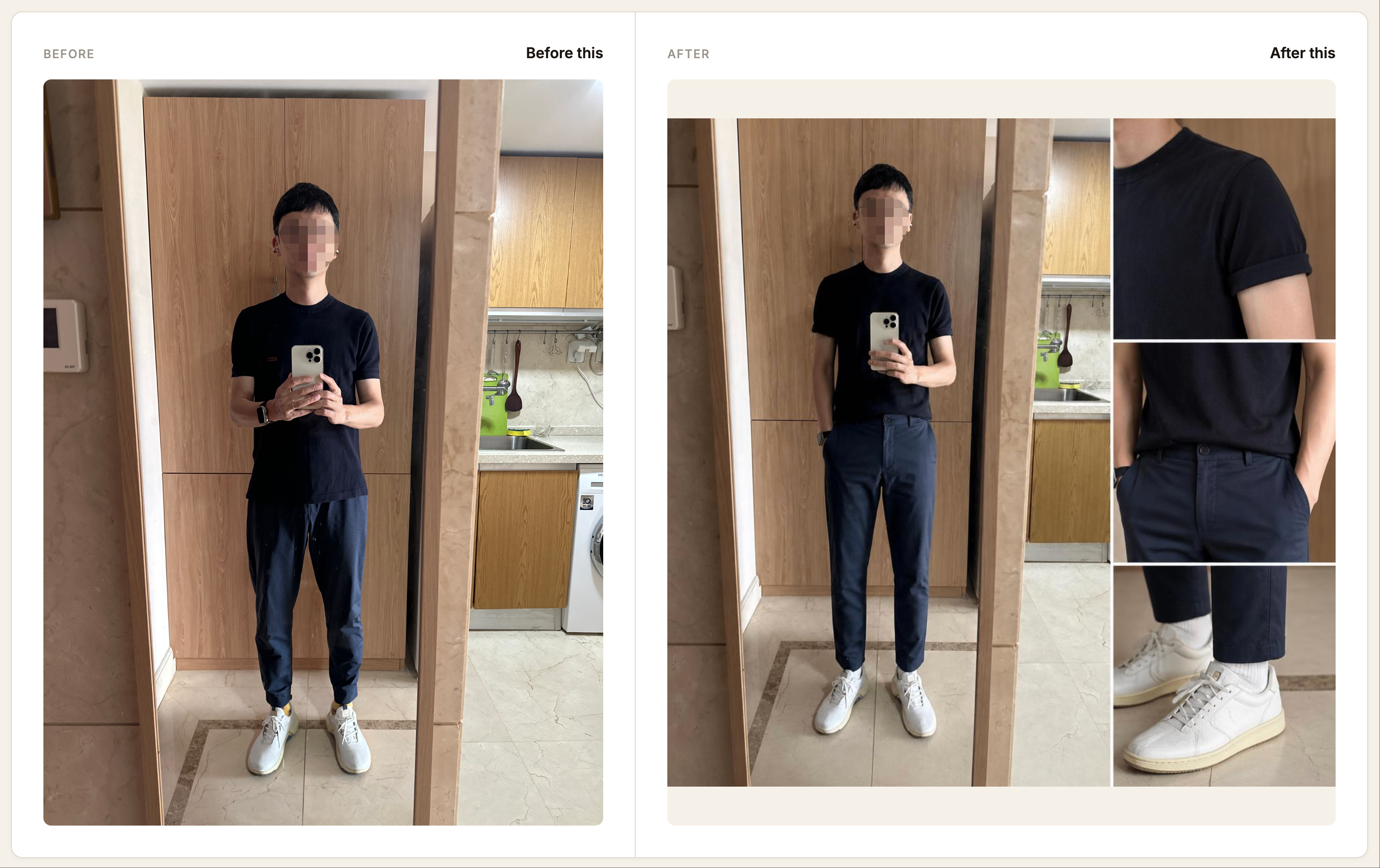
4. A visual before/after comparison is generated.
The AI shows you the complete outfit and the suggested adjustment in a single comparison image, so you can see the difference rather than just read about it.
5. Your look is saved to your history.
Every analyzed outfit becomes a "Look" — saved with the original photo, the AI feedback, and the comparison. Over time, Dress Better tracks patterns across your saved Looks: recurring issues, your most common color misfires, outfits flagged as "safe to wear again."
Real Scenarios Where This Helps
The morning uncertainty problem
You're heading to a meeting and you're not sure the outfit is quite right — but you can't pinpoint why. Upload a quick photo. The AI tells you in under a minute whether the issue is color contrast, proportion, or fabric. You either fix the one thing or wear it with confidence knowing it actually works. This use case came up repeatedly in social posts about outfit rating — people aren't asking because they think they look terrible, they're asking because they need a second opinion and don't have time to wait for one.
Gym / workout looks
Activewear has specific proportion and fabric rules that are easy to get wrong. Fit through the shoulder matters more than most people think — a slightly too-wide shoulder on a compression top creates a completely different silhouette than one that sits at the right seam. Layering choices (hoodie over tank, shorts over leggings) add visual noise that can undercut an otherwise clean look. Dress Better analyzes these the same way it would a business casual outfit.
Beach and vacation packing
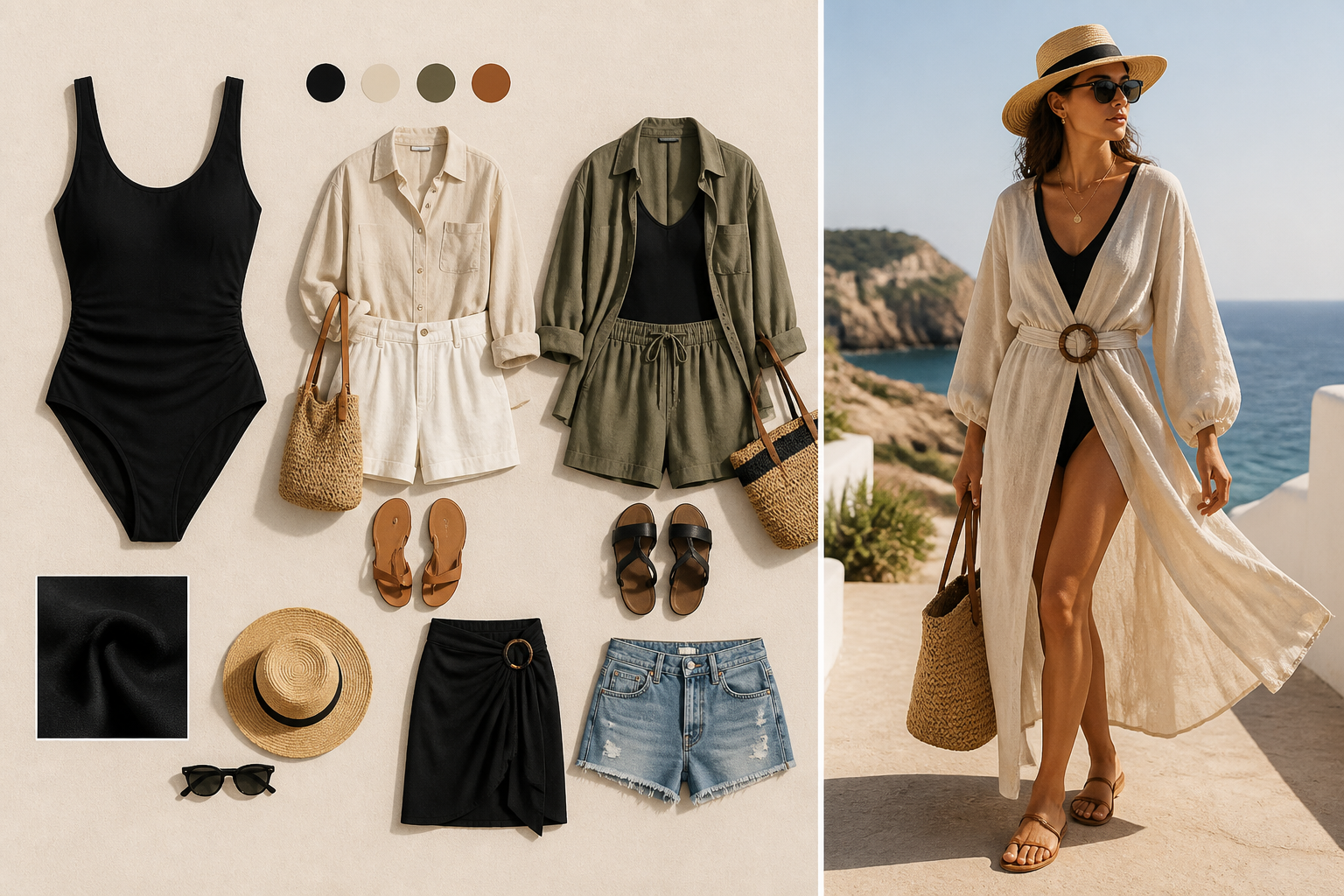
Packing decisions are hard because you're anticipating multiple contexts at once. Dress Better can evaluate individual outfits for specific occasions — beach day, resort dinner, casual exploring — so you pack purposefully rather than just stuffing in things you think might work. If you're heading to a destination where you'll be photographed a lot, getting the feedback before you leave beats discovering the problem in a hotel mirror.
Casual and everyday looks
This is where most people get the least feedback, and where patterns are most likely to go unnoticed. Nobody's telling you your everyday rotation has a recurring proportion problem — that you consistently pair boxy tops with baggy trousers in a way that eliminates your silhouette. Dress Better's pattern recognition across your saved Looks surfaces those trends over time.
Building a personal style baseline
Over time, your Look history becomes a record of what actually works for you — not what works in general. You can see which color combinations you return to, which silhouettes consistently get positive analysis, and where you keep making the same misstep. That's a more useful reference than a saved Pinterest board: it's empirical, specific to your wardrobe, and constantly updated.
What Dress Better Is Not
To set expectations correctly:
It's not a virtual try-on tool. Dress Better analyzes outfits you're already wearing, not hypothetical garment swaps from a catalog. The goal is feedback on your real wardrobe, not a shopping simulation.
It's not a trend tracker. The analysis is based on fit, color theory, and proportion — principles that don't expire with seasonal trends. If you want to know what's on-trend right now, this isn't that tool.
It's not opinion. The feedback isn't "I like this" or "this is cute." It's structured evaluation against consistent criteria. That's why it tends to be more useful than asking friends — no social friction, no aesthetic bias.
How We Evaluated Dress Better for This Article
We tested Dress Better's AI outfit analysis by uploading a range of outfit photos across different occasions — a business casual look, a gym outfit, and a casual weekend fit. In each case, the AI identified a specific issue with precision that matched our own assessment: the business casual photo flagged a proportion mismatch between a relaxed-fit shirt and slim trousers; the gym outfit flagged visual noise from a layered hoodie color that competed with the compression top underneath; the casual look flagged a low-contrast top-trouser combination that visually shortened the silhouette.
The before/after comparison image in each case showed the change rather than just described it, which made the feedback immediately legible without needing to interpret style language.
Dress Better is developed by Felo Inc., a Tokyo-based product company, and is currently in beta with free access on account creation. The product does not require any personal details — no height, weight, or style quiz — before giving feedback. Privacy policy confirms AI inference is handled via third-party providers; the platform processes no biometric data.
The analysis framework is grounded in established styling principles — color temperature, contrast ratio, silhouette proportions, fabric texture interaction — rather than personal taste or trend alignment. That's what makes the output consistent and useful across users with different body types and wardrobe styles.
The Honest Answer to "What Should I Wear?"
The honest answer is: it depends on your specific outfit, your specific context, and specific criteria that a mirror can't fully evaluate.
The reason people keep posting "rate my outfit" online isn't lack of confidence — it's that they want objective input on a genuinely subjective-feeling decision. That demand shows up across every context: gym looks, beach outfits, casual daily wear, work fits. It's consistent because the underlying problem — no reliable feedback mechanism for everyday dressing — hasn't changed.
An AI outfit analyzer gives you that input instantly, privately, and with more specificity than a crowd of strangers on the internet. And because the analysis is logged over time, the value compounds: after ten looks, you start seeing your own patterns. After twenty, you know your defaults — what works, what you keep reaching for that doesn't, and what one or two changes would make your entire wardrobe perform better.
If you're standing in front of the mirror right now asking the question — upload your outfit to Dress Better and get the answer.